Collaboration, Professional Development

Finally back!

There have been 23 nights in October. I have spent 13 of them somewhere besides Columbia, SC. It feels good to be back and I’m ready to stay put for a little while!

About a month ago one of my administrators approached me and asked if I wanted to go to a Working on the Work Conference (WoW) in Columbus, GA put on by the Schlechty Center. I’m a young, enthusiastic teacher with no children…how could I say no? The conference started on Sunday and went until Wednesday. It was a 6 hour drive but another teacher drove with me and it was a great to get to know her!

My district has a new superintendent (in her 2nd year) whose ideas and spending have created some controversy in the community. WoW and the idea of changing the work students do in order to engage them and cause true learning is one of her major priorities. Our district has been sending teachers, administrators and staff members to training since she started. We have also hosted a fair amount of training for our staff. After hearing about the training I can’t say I had a super positive outlook on the conference. However, I reminded myself that you get out of it what you put it. I opted to attend the Design 3 session – Teacher as Guide to Instruction. This session drew me in because of the promise of the use of technology.

We got to hear from Phil Schlechty himself about engagement and standards. I was able to identify with the different levels of engagement – engagement, strategic compliance, ritual compliance, retreatism and rebellion. I also found his distinction between performance standards (what students are able to do) and curriculum standards (what students should know) to be very helpful. He believes that government should give curriculum standards, but that performance standards should be determined by the teachers. I agree that the idea of standards is essential, but we (as a nation) have taken it to the extreme and instituted mass amounts of standardized testing. When I moved to South Carolina I was astonished at the number of tests high school students must take (per the State Department of Education). Are multiple choice tests a true reflection of student learning? Phil Schlechty (and most people I follow on twitter) would tell you absolutely not.

The main take-aways from the conference were:
1) Teachers must get to know their students (their WHO). This is the first and most important thing all teachers should do.
2) Based on their WHO, teachers should create work that allows student choice, reflects their interests and shows that they have truly learned and understood the concepts.

This is usually more project and problem solving based. Students are actually learning to think, not just focus on useless facts. This is not really new (most good teachers already believe this), but it was nice to be around like-minded educators who are ready to do something more than just complain. I also liked being given the verbage and the tools to start designing work for my students as opposed to ‘planning’ lessons. In my specific session we focused on being a guide to instruction, not the sole content expert in the classroom. Collaborating with other experts and creating experiences for students is key.

I know all this training costs money and takes teachers out of the classroom, however if my district & superintendent believe in teaching students how to think and want to reform education, I can get on board. Even if I got nothing else from the 4 days (which I did!), I had the opportunity to experiment with Prezi for the first time! I loved it and I’m excited to play with it more. I Our assignment was to create a stand-alone tutorial for other educators teaching them about and demonstrating one of the design qualities. Enjoy my final product!

Collaboration, iOS, Social Media

Twitter = Success!

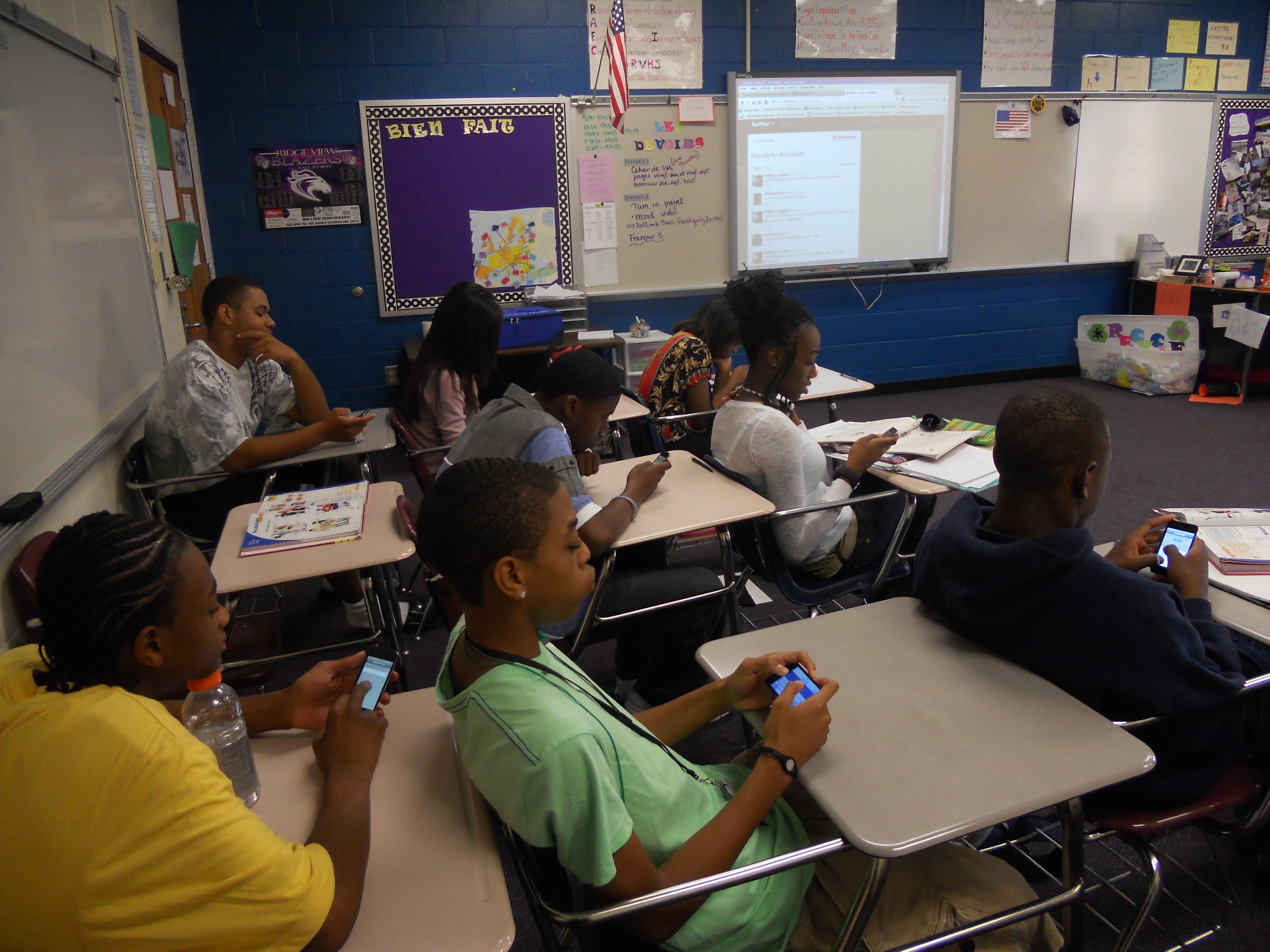
We just finished our conversation with @IDEM_in_English πŸ™‚ My students were interested to discover that they are at a boarding school in Montpellier. We tweeted in French and @freddav’s students tweeted back in English.

Here are the logistics (from our end):
*I moderated student tweets using our class account (@rvhfrancais1) and the hashtag #rvhsidem.

*I displayed the twitter feed on my computer connected to the smartboard so that students could see what was being tweeted.

*My students used the class set of iPod touches to submit their tweets to me using this form.

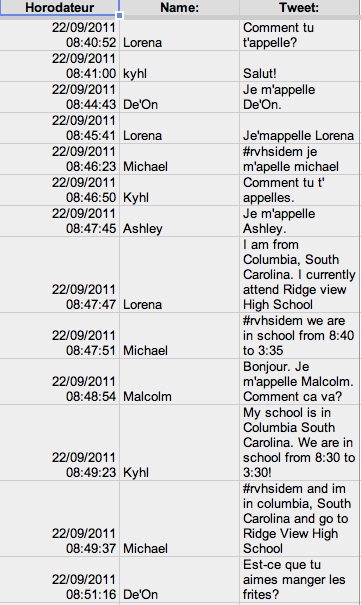
*Their responses showed up in a nice, organized spreadsheet.

*Using my second computer (not connected to the smartboard), I copied and pasted their tweets with their name and the hashtag into twitter. This worked really well and allowed my students to take ownership of their tweets (they loved it when the French students responded directly to them). I was able to add their tweets quickly and I didn’t have to do a lot of typing. If i noticed that students were making mistakes, I talked to them about it. If we they wanted to respond to a tweet but didn’t know how to in French, I helped them find the words. We did tweet some in English since they’ve only been learning French for 5 weeks.

*Before the conversation started, I set up a Twapper Keeper so that our hashtag was archived. This will be helpful in the future so that we can go back and see what happened in our first conversation!

My students not only were able to communicate in French with students in France, they were also able to learn about their culture. I hope we’ll be able to collaborate again so that both groups of students will be able to grow πŸ™‚

Update: We even made the news in France!

Collaboration, Social Media

Connecting Students through Twitter!

When I first heard about Twitter, I wasn’t interested in joining. I thought it was a bunch of celebrities complaining about their lives (stupid!). Then about a year and a half ago, my husband convinced me that it could also be a powerful tool for educators. I had no idea what a PLN was and I was clueless to the amazing resources just a click away.

At the beginning of last year (fall 2010), I created class twitter accounts and a facebook profile so that I could communicate homework and other assignments with my students. {Side note: I strongly believe in meeting my students where there are (i.e. Facebook & Twitter). More on social networking & education for another post!} I also experimented with my French 2 students and twitter. They read an article and then we had a class discussion about it. Afterwards, they created twitter accounts and we used the hashtag #rvhfr2 to tweet about what they thought. The local news station ended up running a story and my students were wonderful.

Since then, I’ve tried to invest more time in my PLN (@mmelayman and this blog). I’ve gained a lot from other educators around the world and this summer I decided I wanted my students to be able to learn from people around the world too (they’re learning a world language after all!). I knew that I wanted to use twitter to find other teachers to collaborate with but I was procrastinating….until I found @TiceChampagnole and twittclasses! I was so excited to find a list of teachers in France and Canada that use twitter that I stopped being lazy and immediately contacted him. He suggested I contact @freddav and his class – @IDEM_in_English.

SO…my super exciting news is that on Thursday our classes will be tweeting together! His middle school class and my high school French 1 class will be “talking” on Thursday morning between 8:40 and 9:30am EST. My students have only been taking French for 5 weeks, but I think this will be a great experience. My students will be tweeting in French (for as long as they can with the vocab they know) and his students will be replying in English. There are still some details to be worked out (hashtag, individual vs class account, what to talk about), but I’m really excited about the possibilities of this collaboration. How COOL that my students in South Carolina will be communicating in real-time with students in France? Blows my mind πŸ™‚

Update: This morning I told my students about what we’d be doing tomorrow..their minds were also blown. Their homework tonight is to come up with questions they can ask the French students (in French and in English). They seem pretty excited! After a trial and error this morning with twitter (student access is limited in our district), I decided to use my class account. My class will be tweeting from @rvhfrancais1 (I will be moderating their questions and responses). Our hashtag will be #RVHSIDEM.