Collaboration, Google, Kuwait, Professional Development, Social Media

What have you been doing lately to become a better educator?

Last month, I bookmarked an article to read – Technology Doesn’t Teach, Teachers Teach by Bill Goodwyn. As I was finally reading it this morning, this quote really jumped out at me:

…we urge our colleagues in the education community to increase their efforts to provide not only the resources to our teachers, but also the necessary professional development [not always mandatory]. We must recognize that the teacher-student relationship comes first. Only then will we continue to see improved results in the wired classrooms of tomorrow.

This got me thinking about what I’ve been doing recently in the professional development category. I’ve been giving PD to our staff, but what have I been doing so that I am becoming a better educator? I’ve also been challenged recently as to why a Technology Integration Coach would need PD other than the IB training offered. Here are some of the PD opportunities I have been seeking out and some of my thoughts…

I don’t do much educational reading over the summer. I rarely get on Twitter and don’t touch my Google Reader. Some may criticize this, but for me it’s a much needed break (especially this year). As we’ve gotten back into the swing of the school year, I’ve been fortunate to have the time each day to spend time reading through my blogs and keeping track of what’s happening on Twitter. I’ve found new people to follow and blogs to read. Although I cherish how my PLN has grown during the last 2 years, I also find myself overwhelmed by all of the educational material put out there on a daily basis. What is actually quality? Who is just trolling for views? Even after you pare down all the information, there is still an incredible amount that is worth reading and using – who has the TIME to do that and how do you choose which tool or idea is best? But attempting to answer these questions is why Twitter and blogs have been and continue to be great places for me to go for self-guided PD.

We are now working at an IB school with all three programs (PYP, MYP, DP). Training teachers in IB is (understandably) a top priority. We currently attend weekly meetings to work towards being category 1 ‘certified’ (we won’t actually get a level 1 certificate, but we will be able to attend category 2 and 3 workshops). It has been very interesting to learn about the IB and MYP curriculum. A lot of it is just common sense & good teaching but quite a bit more is so incredibly different from what I did in the States. I’m eager to learn more in order to collaborate with teachers to integrate technology into the entire IB curriculum.

Working in a Google Apps for Education District and using Chromebooks in my classroom inspired my interest in Google Edu. After attending the South Carolina Google Apps for Education Summit in June, I knew I wanted to learn more. Although I would love to attend a Google Teacher Academy, it’s probably not going to happen in the near future. Another goal of mine is to become a Google Certified Trainer. The first step towards achieving Trainer level is to become a GAFE ‘Qualified Individual.’ I’m currently working my way through the modules and I’m half-way there! I still have the longest three modules & exams to complete – Calendar, Docs & Sites. I’ve already picked up so many tips, tricks and ways to incorporate Google into the classroom that I’m excited to keep going. As I continue to learn more…I’ll be sharing the love on Twitter!

One of the ways in which I have grown as a teacher is becoming a ‘sharer.’ I don’t want to just consume on Twitter and blogs. I want to help people through collaboration. I’ve slowly been doing a better job at this – first in my department in SC, then in my district, through my Twitter & blog and more recently by presenting PD to other teachers. While still in South Carolina I was fortunate to have the opportunity to present at a SC AATF workshop, at the SCFLTA conference and at the GAFE Summit. This year, I’m adding presenting to a new staff and presenting at international GAFE Summits to the list. My husband and I were accepted to present at both Bangkok and Mumbai. My presentation is titled “Conjugating Google Apps in the World Language Classroom.” This will be a great opportunity to meet and learn from new colleagues in educational technology from around the world.

But why do all this? Would I still have a job if I didn’t spend hours each day forcing myself to go above and beyond what is expected? Probably. Most people have no idea what I’m doing on a daily basis for my own professional development. Would I feel good about myself if I wasted my time? Probably not. I’m eager to learn in order to help our teachers implement technology meaningfully. Actual technology might not be changing on a daily basis, but HOW people are using it does. I won’t claim to know everything but there sure are a lot of resources out there that can help me (slowly) come closer. I also can’t forget that I am no longer in the classroom; I’m not using technology with my students on a daily basis. My best ideas seemed to come to me in the moment…how can I keep them coming? I don’t want to lose my connection to meaningfully implementing technology in the classroom. The only way to stay current and relevant is to push myself always be ‘better’ than yesterday.


1:1, Collaboration, Google, iOS, Kuwait

My foray into Elementary

One of the first official things we’ve been asked to do as Technology Coaches is to go into every classroom in the elementary (Pre-K through grade 5) and do a short introductory iPad lesson. We met with the Primary Years Programme coordinators and the Elementary iPad Advisory Group (made up of 7 teachers) to create and refine our ideas for our lessons. It was decided that the most important concept before the students received their iPads was how to treat it (where it should/shouldn’t go, how they should/shouldn’t hold it).

To get started, we created a sign-up sheet for the teachers in Google Docs. We then sent them an email with the link telling them a little about what we wanted to do and asking them to fill in their information.

As a team, the three of us decided to split the grades so that our lessons would be able to be tailored for the target age group. After my two gentlemanly colleagues had chosen, I was left with 3rd grade and half of 2nd. I was a little hesitant and nervous at first as I’ve never worked with students younger than grade 9!

I emailed my elementary counselor friend for some advice, gave my creative juices some time to flow…and voila I had an idea! Using the pictures and cartoons that the guys took and drew, I wrote a short picture book for the students. I based my story off of Are You My Mother? by P.D. Eastman. Here is my book (written using a Google Presentation)…

My first class this morning was a 2nd grade classroom. I started by introducing myself to the students and told them that I work with Mr. Jeff and Mr. Smith. I also explained how we would be coming into their classrooms sometimes to work with their teachers and that they would see us around the school. Before starting the story, I had them read the title and make predictions about what the story was going to be about. While I was reading the story to them, we talked about what made the iPad sad and happy. We talked about how the iPad wouldn’t like the canteen because she doesn’t like food, wouldn’t like the bathroom because she doesn’t like water and how she doesn’t like being up too high or down low. The story ended up being more interactive than I thought it would be…for each picture the students tried to find the iPad and it become like a “Where’s Waldo?” game.  It was fun and they really seemed to get into the story 🙂

I then asked them for their help. I told them how I knew a little boy who needed their help deciding how to treat his iPad. For each drawing (thanks bunches to Matt!!), they raised their hand if they thought it was a good way or a bad way to treat the iPad. Before showing them the “answer,” I had a couple students share about why they thought it was good or bad. We talked about why it would make the iPad happy or sad and I reiterated to them that I would be sharing their advice with the little boy. Before letting them switch to question mode, the teacher and I steered them towards giving me advice about what should be put in the iPad (only charger, headphones & case), what shouldn’t be put with the iPad in their backpack (no food/drink) and how the iPad should always stay in the keyboard case (unless a teacher tells them differently).

When I took out my iPad to demonstrate some of the things that might make the iPad happy or sad, they were in awe (they literally cooed when I took it out of my bag!). They loved seeing it and were excited to be able to get their own soon. I then let them ask me questions. I quickly saw that there were going to be WAY too many questions in the time we had (the whole lesson lasted about 30 minutes), so I asked them to talk with their table groups in order to come up with 1 question. This was great because they had to work together to pick a question and then also to pick who would ask it.

Overall the lesson went way better than expected! The students were adorable, asked great questions and had great advice! It was so different to be in a lower elementary classroom (as opposed to high school) where the students are eager to share and thirsty for knowledge. They really seemed to connect with the characters in the story…let’s just hope they remember when they get their iPads! This afternoon I’ll be working with a 3rd grade class. Who knew elementary could be so much fun? 😉

All the credit goes to Matt for this cartoon!

Update: Today I walked into a 3rd grade classroom and was told they didn’t have a projector…uh crap?! Luckily I created my book as a Google presentation and have the Google Drive app on my iPad. I had the students gather on the carpet and read them the story on my iPad 🙂 It worked really well…maybe even better than when it’s on a big screen!

Update #2: I had my first experience with KG1 students today! Going from high school to elementary was a big jump, but going from 2nd & 3rd graders to 3 & 4 year olds was almost as big. They are SO tiny! The class I was in was sitting “criss-cross applesauce” on the carpet. Each student had a piece of tape with his/her name on it and they had to keep their bums on the tape. They don’t have projectors in the KG1 classrooms, so I used the iPad as a book strategy. I also cut down on the examples of how to hold the iPad after the story. I brought the keyboard case (sans iPad) and let each child stand up to practice “hugging” it. They all clapped for each other and it was adorable! Some other adjustments I made – we skipped the predicting about the story and the giving advice part. I did allow them to ask questions, but they didn’t really know how to so they told me some stories instead. Incredibly cute…but no way could I teach little ones all day! 🙂

Collaboration, Kuwait

Day 1 out of the classroom

Today is my first school day in just over 3 years that I am not teaching French. Wow…that’s a pretty big statement! Although it feels good to no longer be the short term teacher this year, it’s also a little weird to think about!

Luckily we have a great middle school French teacher who invited me to come into her classroom this morning. Her students are learning how to interact with people they’ve just met. I “surprised” the teacher by popping into her class. We then told the students that I only spoke French (they were a little suspicious when they asked my nationality 😉 and they proceeded to ask me questions and get to know me a little better. It was fun to pretend and an awesome idea on the part of the teacher! The class seemed to enjoy it and I hope it helped them learn a little too. I’ll be going back this afternoon to surprise another class 🙂

1 Two 1, Collaboration, iOS, Kuwait

Advice needed for Technology Coaches

In February, my husband and I were hired as Technology Coaches at an international school going 1:1 this fall with iPads. This position was a brand new position and we were told we were hired because of our experiences working in 1:1 environments and giving PD. We found out a couple months later that they had hired a 3rd coach to work with us (no longer would we be working as a husband-wife team, but with another person whom we had never met). Upon arrival in August, we found out that the three of us would be working as a K-12 team (our school has about 1800 students and is divided into divisions – elementary, middle, high). We are excited about this new venture, but are in need of all the help we can get in order to be successful. As a team, the three of us came up with the following job description….

The primary role of the technology coach is to collaborate with teachers in order to
integrate technology in a meaningful and effective way in their classrooms. Responsibilities may include:
– assisting teachers in lesson planning regarding the integration of technology in ways
that support teacher goals and further student achievement.
– facilitating school-based high-quality professional development across all grade levels
(prek-12) and subject areas.
– meeting and working with teachers in teams or individually on an ongoing basis to refine
 their knowledge and skills. Examples include in-class coaching, peer observing,
and/or modeling of instructional strategies.

It is up to the three of us to make the K-12 vision of the admin a successful reality. If you have experience as a Technology Integration Coach (or a similar title), working as a K-12 team of teachers…or any other relevant expertise, please share below!

MANY MANY MANY THANKS!

Chromebooks, Collaboration, Google, Professional Development

Gatorade, Google, Sweat & Social Media #scms12

Day 1 is officially over! Although we didn’t win the Chromebook at the end of the day, it was a decent day. During the keynote by Jaime Casap I found myself nodding along with almost everything he said. To see what people were saying during Jaime’s keynote (and throughout the day), click here.

My session was immediately after the morning keynote. During my 2 years of coaching high school Track & Field, I initiated using social media and google apps with the other coaches, the athletes and the parents. I had a lot of great success! These ideas could also be used for any school group (magnet programs, clubs, after-school programs, etc). I included several links this morning, including one to the ‘fake’ team website. Below is my presentation…enjoy!


My husband also did a session about classroom management in a 1:1 environment. I heard it was a must-attend! #proudwife

Chromebooks, Collaboration, Google, Professional Development

South Carolina Midlands Summit #scms12

Good morning!

Today and tomorrow mark our last 2 days working with our school district before heading out. We will be attending (and presenting at) the SC Midlands Summit. I’m incredibly excited that we have such a great opportunity right in our own backyard! I know a lot of work went into putting this conference together and I’m incredibly proud to have worked with the women who orchestrated it (MaryAnn, Donna, & Pam).

Later I’ll be posting my presentation:
Gatorade, Google, Sweat and Social Media
Ever feel like coaching is taking over your life? In this session you’ll learn strategies to utilize Twitter, Facebook & Google Docs to save time, become more effective communicators and better coaches, regardless of the sport.

But for now…check out what you’re missing and follow along!
#scms12
Featured Speakers
Wednesday Sessions
Poster Sessions
Thursday Sessions

1 Two 1, Chromebooks, Collaboration, Google, Social Media

#RVKony Day 2 w/ @Invisible Roadies @ICDeepSouth #KONY2012

Whew! Day 1 was a great success (in my humble opinion)! My students stayed on task and made some great comments on their articles. They loved being able to annotate a document at the same time and thought it was the coolest thing that they could see what their partner was doing to the document in real time. One of my biggest challenges for Day 2 was finding an online platform for my students to discuss what they read and #Kony2012. This proved to be quite difficult! Chatzy is blocked with no hope of becoming unblocked. I didn’t want anything complicated that students had to “learn” (left out edmodo, Campfire, etc.). I also needed something that identified them and that I could moderate (left out TodaysMeet, etc). One of the ITS at another high school in my district suggested Google Groups. Since we are a Google Apps for Education district, I took this idea and ran with it!

1. When students walked into the classroom on Friday I had these instructions on the board…

2. Students in the outside circle had these directions waiting in their email…

3. In addition, if students in the outside circle expressed an interest (on their survey) of tweeting, they also had these instructions…

4. Students on the inside circle discussed the Kony 2012 video, Invisible Children, the articles they read and their thoughts & opinions on those issues out loud. I moderated this discussion if needed (although one of my classes did so well I barely said a word :)).

5. Students on the outside circle weren’t allowed to say anything out loud…they expressed all of their opinions on the discussion board and Twitter while listening to the inside circle. I embedded both the discussion board and the #RVKony TweetChat into a google site, however the students were having trouble viewing them. That’s when I added the link at the bottom of the page so that students could go independently to the google group.

6. While all students were discussing in both circles (out loud and online), I had the TweetChat on the board so all students could see what was being said on Twitter.

The day went incredibly well and I was extremely proud of my students! One discussion got quite heated while another one went so smoothly I barely had to say a word. A couple highlights from the day..
*my 3d period only participated in the online discussion because we were watching the Kony 2012 video in the gym with the Invisible Children Roadies (Deep South team).
*we were lucky enough to have Laura (from IC) come spend time with my 5th period class. She sat in the inner circle and joined the discussion. It was an amazing asset to have her there with us! (and she was impressed by how well read the students were!) In the future, it would be great to have a Roadie with each class, if possible.
*a couple other teachers/classes in the school participated in the online discussion. I tried to get the word out (sent an email about FREE lesson plans!) but it didn’t catch on quite as well as I would have liked. But this project could definitely become a larger school project with time.
*one of my students chose to come back to my class for the last period of the day and help us tweet out what students were saying (on discussion board and in class). He struggles in French, however something about this issue connected with him. He was planning on skipping and going home, however I convinced him to come to my class and help out with Twitter.

I encouraged my students to create their own opinions from the information. I didn’t care if they agreed or disagreed with Invisible Children & Kony 2012, I just wanted them to have an educated reason for what they thought. If you want more information, here are some of the resources I gathered.

This week was one of those weeks were I love being a teacher. Educating students about current events, encouraging them to think and create their own opinions, getting them involved in a REAL discussion and seeing how much they care…priceless. 🙂

1 Two 1, Chromebooks, Collaboration

#RVKony Day 1 lesson plans…simplified

1. I found articles and information pertaining to Invisible Children and Kony 2012.

2. I converted each article to a pdf using online-convert (thanks to Richard Byrne!). I uploaded each document to Crocodoc (thanks to Jeff Layman!) so that my pairs could analyze the article together.

3. Students took this survey before class.

4. I paired students and assigned them articles based on who they did (or did not) want to work with, how much they knew about the issues and their strengths and weaknesses as students. Each pair received a different article.

5. I created a google doc with the instructions for day 1. I made a copy for each pair and shared it with only those 2 students. The only thing that changed between each document was the link to their article (HERE).

6. I gave students one 45 minute period to work with their partner and get ready for the discussion that will take place tomorrow. More info on those details coming soon!

Participate in the discussion tomorrow! #RVKony

1 Two 1, Chromebooks, Collaboration, Google, Social Media

#KONY2012 is coming to us! #RVKony

Today is a day I love being a teacher! I’m so excited and have so many ideas in my head right now I just need to get them out there. Hopefully this will also help get people involved so that these ideas turn into something real for my students and everyone involved! Update: Thanks to everyone who has read my ramblings! I have a pretty good plan laid out now…check below!

This Friday (only 2 days away!) is the last day before Spring Break and the 5th annual visit from Invisible Children. I first learned about IC when the “Roadies” came during my 1st year teaching (spring 2010). This encounter inspired my husband and I to donate on a monthly basis to the Legacy Scholarship Fund. I’ve kept up with IC but our donation is directly debited and I don’t have to “do” a whole lot. When I watched the Kony 2012 video that has created so much controversy throughout the last month, my passion was reignited. I want to help my students get educated, care about something and DO something about it. This Friday, I know my students hearts and brains aren’t going to be into learning French (Spring Break!!!), so I want to get them educated about what’s going on in the world and help them form opinions concerning a real-world topic (whether they agree with me or not). Here’s my plan:

*Thursday I will be pairing up my students (update: here is the survey I gave them today). I will then be giving each pair an article to read and discuss (links to come). The articles will range from very positive to very negative to neutral to purely informational (on my way to finding & sharing lots of info). Since I’m teaching in a 1:1 classroom, I want the students to be able to collaborate together online (and not print off hundreds of articles). Update: Right now I’m planning on either using google docs (document for each article, share w/ students, they collaborate) or crocodoc. Still playing around! I am still figuring out exactly how to have my students do this in part while using our Chromebooks. Ideas welcome!!!

*On Friday most of my classes will be “discussing” what they’ve read. Each pair will be split up into two groups. One group will be the inside circle and will be discussing their opinions out loud. I want to allow them to share what they read/learned and the opinions they formed but I also want to have guiding questions in case the discussion stalls. The second group will be the outside circle. These students will be using Chromebooks to converse through a back channel. Because Twitter is not reliable at my school (https is blocked), I am experimenting with different websites. Right now I’m probably going to be using a premium room on Chatzy.com (update: no I won’t! It is blocked at our school and won’t be unblocked). I love the simplicity & look of TodaysMeet, but don’t want my students to have so much freedom and anonymity. I don’t want them to have to learn a whole new platform, it needs to be simple and fast! I will be moderating both the spoken and online discussion. Any other ideas for discussion rooms that can be moderated? Update: Adobe Connect doesn’t work with Chromebooks. Tweetchat is blocked too. Campfire is currently looking like the best alternative but I’m not the biggest fan. Even newer update: Thanks to some wonderful people in my district, I created a google group. This group has a discussion board (not a chat room). Students will be able to create topics and reply to each other. I then created a google site (only viewable if logged into the district domain) and embedded the discussion group. Right now I’m working on finding a way to embed the Twitter discussion into the site (#RVKony). Things I’ve tried – direct from Twitter, Hootsuite, FeedBurner.

*ONE of the things I’m really excited about is my 3rd period. The IC Roadies will be with us the entire period so we won’t have time for the normal discussion. However, my class has been given permission to bring our Chromebooks to the presentation. Which means they’ll be able to have a live online discussion while they are watching the Kony 2012 video for the first time (!!!!).

*Where I get even more excited is all the possibilities!! Here are just a couple of things I’ve thought of…
-other classes in the school can join our back channel chat room and discuss the issue in real time…even though they are in different classrooms (now if I can just get some other teachers on board. Update: I have at least 1 other teacher who is willing to try and sent an email to our entire staff.).
-while each class is discussing (aloud and online), I’d like to designate a couple students to use their phones to tweet out using #RVKony. This way what is happening in our classroom will also be a discussion with other people around the world. However I need a way for my students to see the Twitter discussion without using Twitter. Any ideas for how to search & view hashtags (w/out Twitter)? Update: Thanks to a friend on Facebook… hashtags.org and tweetchat.com (tweetchat is blocked for our school, hashtags is not). Newer update: Still figuring out how to embed into my google site (hosted by my district). See above for details.
-I want to get the word out NOW, not after the fact. I want my students to participate in a discussion with their peers and people around the world (#RVKony). I want them to realize that the world is bigger than them, bigger than our school, bigger than our city. Please share with anyone and everyone! The more people that participate in the #RVKony discussion on Friday (9am-3:30pm), the more meaningful it becomes.

These are my rough ideas and I don’t have much time to throw it all together. But it’s not the morning of and I’m confident that everything will come together!

1 Two 1, Collaboration, Google, Professional Development

Let’s take a step back

So I’ve talked a lot about our district going 1:1 but I haven’t given many details. Implementing 1:1 in a district of 25,000 students and 30+ schools is a big undertaking! So here are some of the logistics…

*all schools are site-based. So the district office gives recommendations, but the schools (principals) have the final say. This applies to devices chosen, professional development, discipline policies, etc.

*K-2 will NOT be going 1:1, grades 3-8 will be going 1:1 by grade level and high school will be going by thirds

*Phase 1 (February 2012) – grades 5, 6 and 1/3 of each high school (based on student population, ~26 teachers at my school). Phase 2 (August 2012) – grades 4, 7 and next 1/3 of HS. Phase 3 (TBD 2013) – grades 3, 8 and last 1/3 of HS. At this point high schools MAY allow devices to go home instead of classroom sets.

*all high schools & elementaries chose Google Chromebooks, middle schools have chosen a variety of devices (iPad, Android tablet, Chromebooks)

*all high schools & elementaries have carts for 1:1 teachers with class sets, middle schools are doing homeroom models and also allowing students to take devices home

20120316-065849.jpg

20120316-070019.jpg

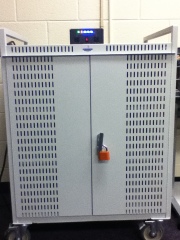
*Before we ever saw our Chromebooks, our Integration Technology Specialist (ITS) (Tami) had her work cut out for her! She received over 700 Chromebooks. Each one was assigned to a class set (district asset & serial numbers were recorded), set up to the network (we have a special Chrome wireless network), labeled and inserted into a cart.

20120316-071435.jpg

*Tami created (and shared) a google document with all of this information so that we (teachers) could assign Chromebooks to students (my students use the same CB every day). The original spreadsheet includes information for all teachers.

*Tami started holding professional development for the 1:1 teachers at my HS in late fall. We received our locked carts in nid-February. We were required to attend a full day of PD on March 1st to obtain the code to unlock our carts. Unfortunately we didn’t get to all of the following agenda (everything took much longer than anticipated!). I helped present the session on “Unlocking the Chromebook Power” using an adapted version of my SCLFTA presentation.

*The morning was spent determining which CB numbers (1-27 for my cart) matched the asset tag info that Tami collected (see above spreadsheeet). I exported rosters from my PowerSchool gradebook then copied and pasted my students names and ID numbers into a Google spreadsheet for each class. I then assigned each student to a number (alphabetical order) and converted their ID numbers to email addresses.

*This full day of PD was priceless because we were given useful information and the TIME to do things that we needed to do. I adapted my rules presentation (from Tami) and my user agreement.

*Among other information, we also viewed and discussed the discipline policy. As we go 1:1, I think it is extremely important to have consistent consequences and hold students accountable. Below is an example from another high school in our district.

Whew that was a mouthful! But implementing 1:1 on this scale (or anywhere) is such a huge undertaking 🙂