Kuwait, Professional Development, Social Media

#AISQ8chat – an #IBOLP series

Sometimes I’m really dedicated to blogging. Sometimes I’m not. If I’m absent for an extended period of time it’s because I’m just too dang busy living life to sit and write about it. But there are some pretty great posts floating around in my head (and even written down somewhere!). 😉 In order to prompt me to actually sit down and blog, I need to be so excited about something that I just can’t help myself. After 5 months, today is the day!

Thanks to the efforts and excitement of a lot of my colleagues, #AISQ8 has grown from 4 or 5 people to over 30 in the last year! If that isn’t something to get excited about, I don’t know what is. Besides sharing the great things happening in our school (we were inspired by #sisrocks), I have enjoyed engaging in discussion on a weekly basis ever since Christina and I started #AISQ8chat in February. Browse our 2014-15 topics, 2015-16 topics and all the archives.

Since its beginnings, I’ve wanted to do a multi-week series. Part of my motivation was that Christina and I never seemed to have enough topics to chat about and many times we were still coming up with questions on Monday evenings. But most of it was that I wanted to go further with my colleagues about how (and why) we actually live and teach the IB Learner Profile. Thanks to Heidi and Christina, today this became a reality! [Insert giddy squeal here]

Here are the details & vocab you need to know to participate in the #AISQ8chat Learner Profile series:

  • Everyone is welcome!
  • Starts Tuesday, 10/27, and will continue for the next 14 Tuesdays (except December 22 & 29).
  • View the IB Learner Profile
  • We made up some new hashtags:
    • #IBOLP = International Baccalaureate Organization Learner Profile
    • #IBOLPT = IBO Learner Profile Traits
  • IBOLPT Continuum: ⌧ checking the box <——————————————–> way of life
  • We will be releasing the questions each Sunday (although they will be the same each week, just with a different #IBOLPT).
  • In week 1 we will explore why and how we, as stakeholders in the school community, live the #IBOLPT.
  • We will spend 1 week on each of the IBOLPT starting with Risk-Takers next week.
  • After exploring 6 traits, the week before (12/15) and after (1/5) winter break we will take time to reflect and make some conclusions.
  • Our last chat (2/9) will focus on hiring staff who live (professionally & personally) the IBOLP.

Here are a few tips & tricks I shared with #AISQ8:

  • During our Tuesday slow chats we usually release Q1 by 8am, Q2 at 11am and Q3 by 2pm (just in time for our faculty meetings!). However you are welcome to reply to any question at any point throughout the day.
  • When you have time on Sunday and Monday, start formulating your As to the weekly Qs. Then use Hootsuite to schedule them for Tuesday so that you don’t have to take time away from teaching. [Don’t worry, you can still edit pending Tweets if you change your mind.]
  • When you do have a couple free minutes on Tuesday, browse #AISQ8chat and engage in the conversation. Ask the community clarifying or probing questions. Twitter is your Personal Learning Community – you will get out what you put in 🙂
  • Christina will be Storifying #AISQ8chat every Wednesday morning. Didn’t have a chance to engage in the conversation on Tuesday? We still want to hear from you! Feel free to answer any of the previous week’s Qs from Wednesday to Monday. Please just remember to include #AISQ8chat. You can also add #AISQ8unchat if you’d like.

#AISQ8chat banner 10.27.15

Kuwait, Professional Development

#NESASEC 2015

NESA SEC Certificate of Presentation

This spring I had the honor of being selected by our leadership and the NESA Center to present two teacher workshops at the Spring Educators Conference. This conference is near to my heart as it was where I met Scott McLeod & Jayson Richardson in 2013 and decided to pursue my MEd with UKSTL. This year was special because I got to spend professional and personal time with a great group of educators from my school. The time we spent connecting with each other and other attendees was valuable (I got to finally meet Jeremy and Stacy!).

I enjoy the mix of PD experiences at this conference – keynotes, teacher workshops, 4-hour specialist workshops. Plus the location is always a bonus. This year the theme seemed to be all the ‘other’ skills that students need, not content. I was pushed to think about why we do things in the classroom, how research informs instruction and teacher attitudes. It was the first time I had seen Heidi Hayes Jacob, Bena Kallick, Debbie Silver (absolutely hilarious) and Dylan Wiliam…and I learned a lot from them. They’ve made most of their material available on the NESA Center website. One of my favorite sessions was Dylan’s Formative Assessment 4-hour workshop. I appreciated his research-based approach. Because my colleagues couldn’t attend, I took notes for them. Enjoy!

One thing I would like to see going forward at the NESA SEC is facilitated time for connections. I ‘met’ a lot of people virtually while tweeting but didn’t have the opportunity to meet F2F. During morning coffee or lunch, it would be great to have tables set aside for people who would like to meet up with other educators. I found myself sticking to my comfort zone (my colleagues) which was great for this time but would like to have the organized opportunity to meet other people.

Two of my PEAK 2014 sessions were chosen: Harnessing the Power of Google for Collaboration and Creating a Globally Connected Classroom. Teacher workshops have lost of of their importance at the SEC (understandably) so I was excited to have the number of attendees that I did (not zero!). My resources are available on the NESA page.

Abby (who co-presented with me at PEAK) couldn’t make it to Istanbul for our Creating a Globally Connected Classroom presentation. So she joined virtually. It was the second successful virtual presentation of the weekend! It was a wonderful learning experience and just another reason I’m grateful for the power of technology. My mom even got to watch from Michigan 😉 I’m excited to present with Abby again at the CISD Camp Inspire in Michigan in July!

Professional Development, UKSTL

LAST semester of #UKSTL – I’m a Master

Ahhh…I feel like I can breath! Between finishing up my action research, 2 other UKSTL classes and presenting at 4 conferences (plus 2 leisure vacations)…it’s been a hectic spring!

I’m proud to say that I now have my M.Ed. in Educational Leadership with an emphasis on School Technology Leadership. It’s a mouthful. But after 5 semesters of work, I’m okay with that! In fact I have my Masters +15 with my COETAIL graduate certificate 😉

Here are some fun participation numbers: 37 middle of the night classes. 13 evening classes. 1 oral exam. Connected from 7 countries. I can’t speak highly enough of the UKSTL program (and professors) and the willingness to be flexible in order to accommodate my situation. The program was 100% online however I have classmates that I would greet with a hug.

Being able to say “I did it” feels so damn good. The last two years have been stressful to say the least. But I have grown in many ways and can’t wait to see what this decade holds for me. I stand by my decision to choose a research university with a real campus. #worthit

EDL 669: Leadership for Creative Problem Solving

This was only the second hybrid UKSTL course I had taken (some students were in class while some of us were online). I have to say that I prefer the 100% online; however thanks to Mike, I felt as in class as I could! He rigged up the room at UK quite nicely so those of us online felt much more a part of the class.

This class was facilitated by Tricia Browne-Ferrigno. It was her first hybrid class and she worked continuously to make it worthwhile for all of us. “The purpose of this course is to expand students’ understanding of creativity as a transformative process, essential component of decision making, and core competence of leadership.” I quite enjoyed reading Creative Leadership: Skills That Drive Change (required) and Creating Innovators: The Making of Young People Who Will Change the World (chosen by me). The themes of this class pushed me and helped me grow as both a person and future leader.

My four major assignments are below:

Contracted group project – review of 3 books

And the culminating assignment of the class (and really the entire program)…

EDL 665: School Tech Leadership for Digital Citizenship

In 665 we focused on ISTE Admin Standard 5 (the last of the standards) and educational law with Justin Bathon. Justin was passionate about this course and it showed. This was a topic I had a lot to learn about (and still do). It was a great introduction to educational law and gave me lots to ponder. Being outside the US makes this class slightly less relevant, however I think international school staff should be cognizant of educational law and how it might apply to us.

During 3 of our live classes, we held debates in which teams rotated representing the school, the student and being judges. I find it interesting to note that the students won in all three cases.

Student Digital Speech
RFID Badges
BYOD Implications

My final project was a policy brief that might be applicable to my school. I found this difficult to wrap my head around as an international educator but I chose to examine our acceptable use policy in regards to digital equity.

Professional Development, UKSTL

#UKSTL Semester 4

I know that my fourth semester of UKSTL finished in December. Except it kind of didn’t. I took an Incomplete in ELS 621 in order to finish my action research.

ELS 621: Leading Action Research II

After the summer with Jayson, I worked with Marti Quintero on the implementation of my action research in the fall. This was my first experience both with action research and working with different professors on the same project. Although frustrating at times, I found it beneficial to have multiple people looking at my project from different perspectives. Our tech integration Critical Friends Group met 7 times during the school year with an 8th meeting tentatively scheduled for May. When I wrote my research proposal in the summer I didn’t realize that I would need to finish my research in the fall semester. Instead of cramming it in or reporting on only part of my research, I chose to take an incomplete to do it right. I’ll write more in depth about my research in an upcoming post 🙂

EDL 664: Tech Leadership for School Improvement

When I found out that Scott McLeod was teaching this class, I was pretty pumped. Meeting him at NESA SEC in Bangkok in 2013 is what prompted me to join the UKSTL family. And he’s the founding director of CASTLE. What a great opportunity!

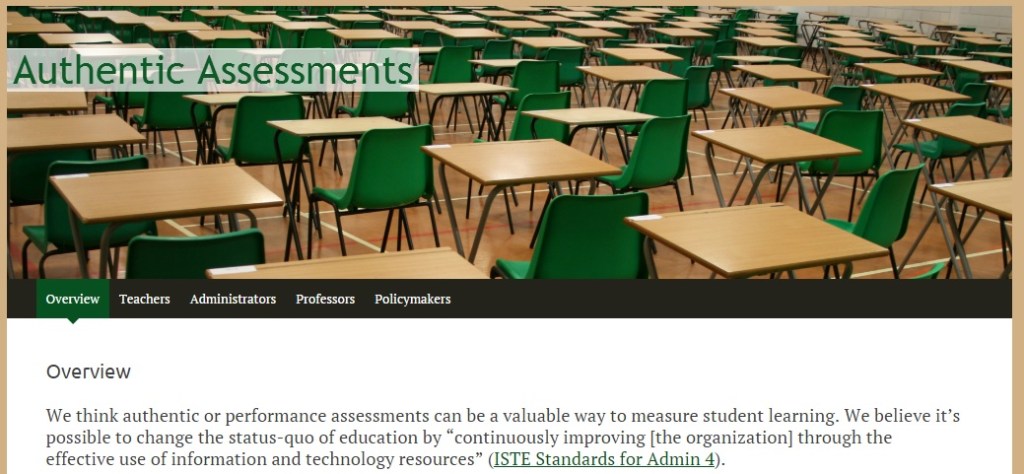
It ended up okay. I appreciated the idea behind the class – inquiry based, self driven. The goal was to build the class together around ISTE Admin Standard 4. Except it didn’t turn out quite as mind-blowing as I was hoping for. I started the class with high hopes and lots of questions. The class was set up on a blog where we all contributed what we were learning. And then we split up into investigation groups. I joined the performance assessment group. Our end product was a website about authentic assessment geared towards teachers, admin, professors & policymakers. I chose to focus on assessment in the International Baccalaureate. Another investigation group created a website about technology integration.

authentic assessment

I would have like to be challenged and supported more. I would have liked to feel more a part of something. I would have liked to have multiple investigations. But the class also forced me to find my own motivation. And gave me a chance to connect with a couple new classmates. I did appreciate Scott’s letter to our class at the end and the chance to give him our honest feedback. I also appreciated that he was a risk-taker. It didn’t work this time but maybe it will next time. I hope the experience and reflections will inform future classes.

Mostly this class made me think about the implications for K-12 education. It made me wonder – how effective (and possible) is open inquiry? Would it have been more possible in a face-to-face class? Can an entire course be dedicated to completely open inquiry, based simply on a standard? This is the discussion I’d like to have now and my biggest takeaway from the course.

Kuwait, Professional Development, Social Media

ISTE, #AISQ8chat, #AfricaEd & Digital Citizenship

As my MEd with UKSTL winds down, I’m disappointed in my lack of reflecting on this blog. At it’s core, my blog is a place for me to reflect on my learning and practice. Unfortunately I’ve realized that a full-time job and Masters at the same time leaves little time for writing. Or I haven’t made the time. My goal is to start putting things on ‘paper’ that have been swimming around in my head for the last year. Starting today!

This week’s #AISQ8 slow chat is all about Digital Citizenship. When Ryan asked if we could do a joint #AfricaEd & #AISQ8chat this week, we were on board. Today we’re reaching more people than we’ve been able to in the past. The power of a hashtag! As we started discussing what digital citizenship is and its role in our connected world, I got to thinking about the ISTE Standards. Each of them (Students, Teachers, Coaches, Admin, Computer Science Educators) mention digital citizenship. But I wanted to compare them. So I quickly threw together this spreadsheet in order to visualize all 5 at the same time. Would love any feedback 🙂

Collaboration, Kuwait, Professional Development, Social Media

Virtually presenting at #MACUL15 from #NESASEC – success!

Our #MACUL15 session just ended and I wanted to blog about it while I was still giddy from the experience. Minutes after the session had ended several attendees had already started reaching out to other educators around the world to connect their classrooms. That’s powerful. When we can inspire educators to think outside their norm, realize the power of globally connecting their classroom and take immediate action…I get butterflies inside just thinking about it!

John and Mary were in room 140D at MACUL in Detroit, MI. Jeff was in our apartment in Kuwait. I was in my hotel room at NESA Spring Educators Conference in Istanbul. We used a Google Hangout to connect 3 continents to present to educators about globally connecting their classroom. To be expected, we had some technical difficulties at first. But as we got rolling, the technology cooperated nicely. This was a first for all of us but John did a great job coordinating the 4 of us. Thanks to all that came and watched 🙂

Our main points:

  • Connecting your classroom has a positive effect on student learning.
  • It’s simple – you don’t need a lot of advanced techy gadgets.
  • Plan with the other teacher in advance. Prepare your students for different cultural norms & to ask quality questions.
  • There are lots of places to start connecting.

Below is our slide deck. We provide links to help educators start immediately (where to start). Check out the Google Form and responses from educators around the world – we’re trying to make it as easy as possible to help classrooms around the world become connected.

PLEASE contact us with any questions or if you’d like us to help you and your classroom get connected. Eager to hear from you and positively impact student learning together 🙂

Collaboration, Kuwait, Professional Development

#MACUL15 – Live from Kuwait (& Istanbul)!

John, Mary, Jeff and I will be presenting at the 2015 MACUL conference in Detroit on Friday. Jeff will be in Kuwait. I’ll be in Istanbul (at the NESA SEC). John & Mary will be in Detroit. We will be in 3 different countries, on 3 different continents, teaching educators how to globally connect their classrooms. None of us have ever done a session like this and we’re excited for a unique approach to presenting!

What we’d love from our PLNs:

  • testimonials from educators & students around the world – Why connect? What is the power of connecting globally? How have global connections transformed your classroom/learning? Feel free to share these with us in any format!
  • join us live! Watch the broadcast or let us know if you’d like to join the Hangout and talk to attendees for 1-2 minutes about the power of global connections.
  • complete this short survey. We’ll give the results to the attendees of the session (and you if you’d like them) so that global connections can begin immediately!

THANK YOU!

COETAIL, Kuwait, Professional Development

#AISQ8chat – let’s talk about #COETAIL!

This morning we announced a live COETAIL cohort in Kuwait starting in September!

Kuwait COETAIL Cohort

To get the excitement flowing, the teachers of #AISQ8 will be slow chatting today about COETAIL. We’d love current COETAILers, grads, coaches, instructors (really anyone who is passionate about COETAIL) to join in #AISQ8chat! The success of the chat depends on YOUR participation 🙂

#AISQ8chat banner 3.17.15

Kuwait, Professional Development

#EdcampQ8 – it’s a thing

This has been an exciting year for progress at AIS. It seems like we’re starting to be more open-minded to trying to new things. It’s been fun!

First semester the ES did a series of 3 Edcamps during weekly staff meetings. Inspired by the feedback, our MS/HS professional development planning team decided to try out the Edcamp model during our half-day PD. Although I’m not part officially part of the team, I helped on the back end. Kudos to Christina, the rest of the team and the entire AIS staff for being risk-takers! To see more details from a different perspective, check out Christina’s post.

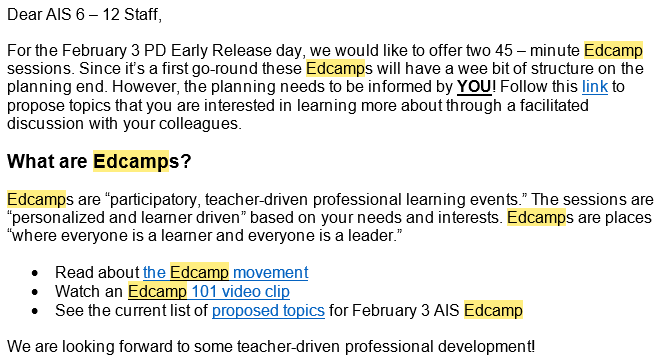
  1. The PD planning team solicited topics and introduced Edcamps:
    1. edcamp1

  2. People who proposed topics were asked if they wanted to facilitate (in the Gform). If they didn’t, the PD planning team asked other staff members to facilitate the proposed topic.
  3. Christina held an Edcamp facilitator ‘orientation’ where she shared information & answered questions.
  4. All staff were asked to sign-up for topics. The facilitators were kept ‘secret.’ This isn’t the pure Edcamp model but the planning team wanted accountability and to keep the numbers low in the sessions. When a topic reached 10-12 participants, it was closed.
  5. Christina assigned topics/facilitators to rooms in the HS for each 45-minute session on a master schedule.
  6. Facilitators were asked to capture the conversation in some way (with a suggestion).
  7. I made a copy of the suggested spreadsheet and then shared it so that anyone with the link could edit. I took notes during our discussion and then emailed it to the participants so that they could add anything they wanted. I also added a link to the master schedule so that other staff members could keep the conversation going.
  8. After our mini-Edcamp, Christina sent out a feedback survey to get an idea of the overall reactions to Edcamp and also to the individual sessions.
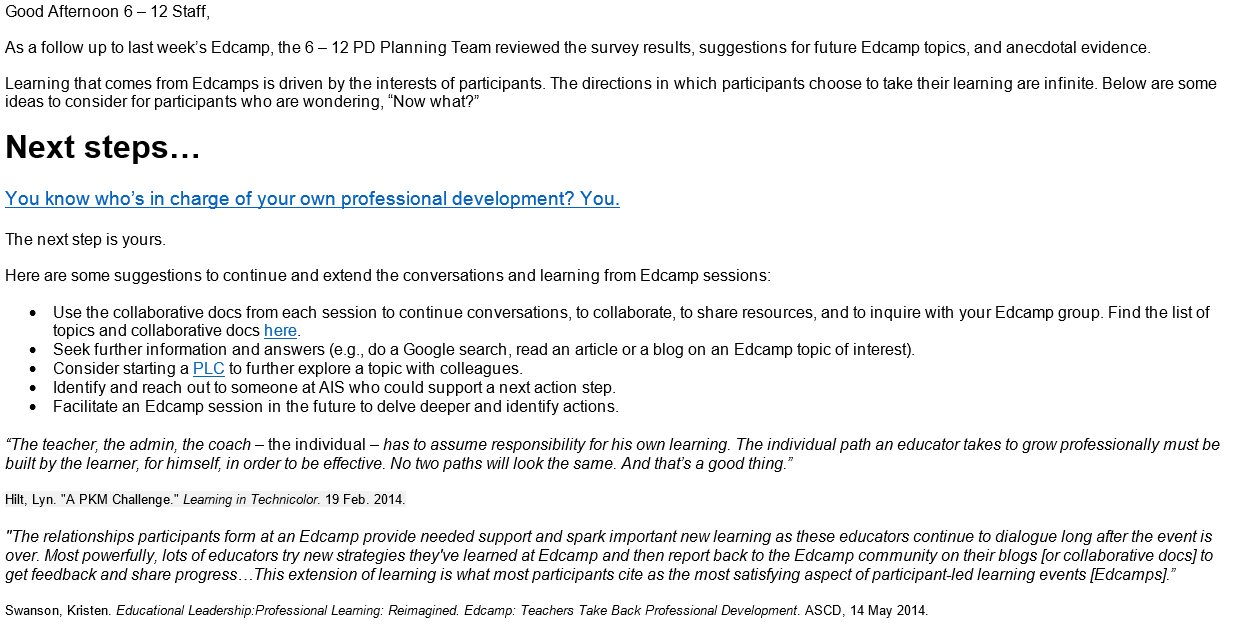
  9. Lastly, Christina sent out an email with suggestions to encourage staff to “continue and extend the conversations and learning from Edcamp sessions.”
    1. You know who’s in charge of your development? YOU.edcamp2

We’d love to hear about other grass-roots Edcamp movements! We’re hoping this can become something bigger and we can host an Edcamp for all of Kuwait in April.

In other news, we’re slow chatting this week over on Twitter. Feel free to join in the fun 🙂 Yesterday the ES did another staff meeting Edcamp. This time it was themed – differentiation. Abby facilitated “Differentiating your own PD.” They discussed using Twitter as a professional learning network for both teachers and students. Love what’s happening at #AISQ8 🙂

Kuwait, Professional Development, Social Media

#AISQ8 is starting a slow chat: #AISQ8chat

Last week Christina emailed six staff at our school to share information about the first ever #nesachat. Then we got thinking about how many staff at our school are actually on Twitter. We were pretty surprised (and excited) that there are 15 of us! For our school, this is kind of a big deal. The dominoes started falling from there: I created a list of all our Tweeting peeps, we settled on a new hashtag (now #AISQ8, formerly #AISK), and started tweeting about our MS/HS Edcamp (#edcampq8).

This week we’re taking it a step further with a slow chat (#AISQ8chat). We’re hoping to expand on what people already know about Twitter and help some of our staff become more comfortable using it as a professional development tool. This week it will be a 3-day slow chat centered around a Twitter K-W-L. Details are below (created by Christina). Please help initiate our staff to the power of Twitter by participating with us 🙂 Looking forward to it!